
Are Marketing-Oriented Generational Narratives Consistent With the Philosophy of Catholic Higher Education Institutions?
Article Sidebar
Main Article Content
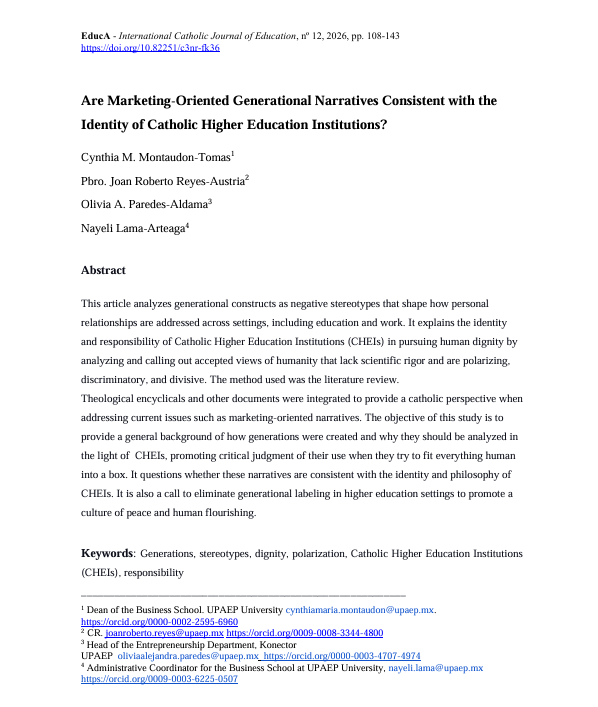
Abstract
This article analyzes generational constructs as negative stereotypes that widen gaps between families and various personal relationships, including work. It explains why these stereotypes should not be used in Catholic higher education when considering age groups, as they are polarizing, discriminatory, and affect human dignity. The method used was the literature review. The objective of this study is to falsify generational narratives, showing their adverse effects on polarizing and dividing society and creating significant gaps in relationships between family generations.
Generations are social constructs shaped by economic and political interests. There is no universal agreement on the years they consider, nor is there a validated theory or empirical evidence to support them. Furthermore, no institute or official body names or validates them, and the leading authority in the field has taken a step back, stating they will no longer use them due to a lack of scientific rigor.
Catholic Social Teachings on intergenerational and intragenerational solidarity, from the perspective of family, will be used to eliminate depersonalizing labels, bridge the gap between the young and the elderly, and unify the past, present, and future in a new alliance that generational confrontations should not tarnish.
Article Details
Section

This work is licensed under a Creative Commons Attribution 4.0 International License.
License and Copyright
The contents published in the journal EducA are distributed under a Creative Commons Attribution 4.0 International (CC BY 4.0) license.
This license allows third parties to share (copy and redistribute the material in any medium or format) and adapt (remix, transform, and build upon the material) for any purpose, even commercially, provided that appropriate credit is given to the original author(s) and the source of publication.