
Sensory-motor and Cognitive Profiles of Children Entering School: School Readiness and the Impact of Settlement Size During the First Two Years of Schooling
Article Sidebar
Main Article Content
Abstract
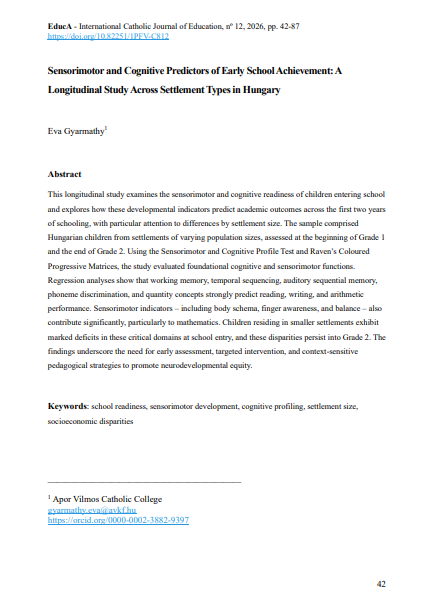
This longitudinal study investigates the sensorimotor and cognitive profiles of children aged 6 to 8 at school entry, with a focus on how settlement size influences school readiness and academic development during the first two years of formal education. Drawing on data from 804 pupils across diverse Hungarian settlements, the research employs the Sensorimotor and Cognitive Profile Test alongside Raven’s Coloured Progressive Matrices to assess foundational functions predictive of academic success. Results reveal that working memory, sequential processing, phoneme discrimination, and quantity concepts are strong predictors of achievement in reading, writing, and arithmetic. Less commonly recognized indicators – such as body schema, finger awareness, and balance – also demonstrated lasting relevance, particularly in mathematics. The study highlights persistent developmental disparities between children from small rural settlements and urban municipalities, suggesting limited compensatory effects of standard educational provision. Findings underscore the importance of early assessment, targeted intervention, and context-sensitive pedagogical strategies to support neurodevelopmental equity and optimize learning outcomes in diverse educational settings.
Article Details
Section
License and Copyright
The contents published in the journal EducA are distributed under a Creative Commons Attribution 4.0 International (CC BY 4.0) license.
This license allows third parties to share (copy and redistribute the material in any medium or format) and adapt (remix, transform, and build upon the material) for any purpose, even commercially, provided that appropriate credit is given to the original author(s) and the source of publication.